Location
Jakarta
Client
UNJ
Project Types
Educational Building
Status
Under Construction
Building Area
40.180 sqm
Site Area
-
Scope of Works
Architectural Design, Interior, Landscape, Mechanical, Structure, Review Master Plan, Electrical, Plumbing
Highlights
Services
Building Planning
Appointment Year
2024
Completion Year
2024
Saudi Fund for Development (SFD) Universitas Negeri Jakarta
The masterplan of Campus A, The State University of Jakarta, is developed to strengthen spatial integration, environmental quality, and accessibility within the campus area. While the existing masterplan is generally well organized, it lacks strong integration between buildings, direct connections to public transportation, optimization of green open spaces, and efficient use of regional infrastructure. Responding to these conditions, the design is guided by four main criteria: Sense of Place, Environment, Integrity, and Accessibility, which together form a coherent and sustainable campus framework.
The proposed masterplan envisions Campus A as an integrated academic environment where buildings, circulation systems, green open spaces, and infrastructure function as a unified system. The campus is not only designed as a place for formal education, but also as a living academic environment that supports social interaction, environmental responsibility, and character development.
Accessibility and Integrated Circulation System
Accessibility is treated as a key element in shaping the campus experience. Vehicular and pedestrian circulation systems are designed to be clearly organized and well integrated, reducing potential conflicts and ensuring safety for all users. Vehicular pathways provide efficient access while maintaining clear boundaries from pedestrian-dominated areas.
Pedestrian circulation becomes a priority, particularly considering that nearly 70% of Campus A UNJ users rely on walking and public transportation. The new masterplan introduces continuous, comfortable, and legible pedestrian pathways that connect academic buildings, open spaces, and public transportation access points. This approach reinforces walkability and creates a more inclusive and human-oriented campus environment.
Green Open Space and Environmental Infrastructure
Green open space plays a crucial role in addressing contemporary environmental challenges and enhancing campus life quality. With a Green Basic Coefficient of 30%, Campus A UNJ has strong potential to implement a robust green open space system. In the proposed masterplan, green areas are designed as environmental infrastructure that improves microclimate conditions, supports water management, and provides social and academic outdoor spaces.
Green open spaces are carefully integrated with building zones, forming a continuous landscape network that strengthens environmental performance while reinforcing campus identity.
Building Zoning and Campus Structure
The campus is organized into functional zones that support academic, social, and public activities. The Educational Zone is placed at the center of the campus to minimize disturbance from road noise, ensure easy accessibility, and allow strong integration between lecture buildings. This central positioning reinforces the academic core of Campus A UNJ.
The Commercial Zone is strategically located in areas with high accessibility and visibility to the general public. This zone supports daily campus needs while acting as an interface between the campus and the surrounding urban environment.
Green open spaces function as connectors and buffers between zones, ensuring a balanced spatial relationship between built areas and the landscape.
Educational Building and Center for Development of Character Education
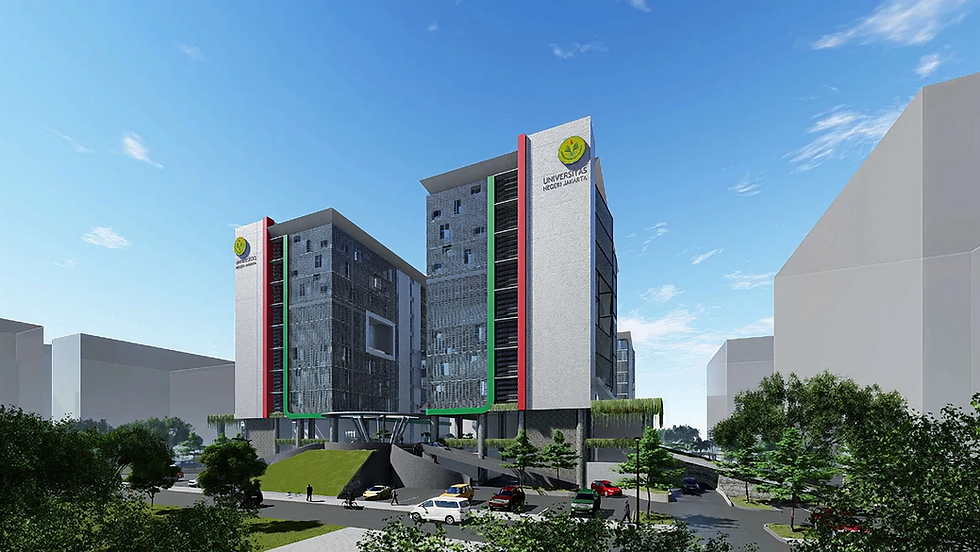
The Educational Building and the Center for Development of Character Education are designed as key architectural elements within the campus, reflecting both academic excellence and environmental responsibility. The design approach combines teaching and learning functions with maximum thermal comfort, while ensuring that the building form aligns with the image and values of UNJ as a green and character-driven institution.
A green architecture approach is fundamentally embedded in the building design. Environmentally friendly construction materials are selected to minimize negative impacts on living organisms, while indoor environmental quality is carefully managed to promote health and comfort. The building is designed to reduce dependence on external water sources by incorporating water-efficient systems, emphasizing the idea that human occupation of land must be balanced with ecological responsibility. Architectural expression is also considered as a narrative element, where the building conveys a story of sustainability, freshness, and academic identity, supported by the optimal use of renewable energy, particularly solar energy.
The building mass and facade are shaped through thermal performance analysis, ensuring effective control of heat transfer and indoor comfort. Facade elements function as veils that reduce solar heat gain while maintaining visual permeability. Thermal comfort is further enhanced through orientation, shading, and material selection, resulting in an energy-efficient and climate-responsive building.
Water management is integrated through the application of a retention pool system, which supports drainage, reduces surface runoff, and contributes to environmental sustainability within the campus.
The building design also complies with the Green Basic Arearequirements as regulated by Local Regulation Number 38 of 2012 on Green Buildings, ensuring sufficient green area allocation within the building site.
Educational Building Configuration
The Educational Building complex consists of multiple towers that accommodate different faculties while maintaining spatial integration. Building I, comprising Tower A and Tower B, primarily serves the Faculty of Engineering and the Faculty of Economics with integrated classroom facilities. Building II, consisting of Tower C and Tower D, accommodates the Faculty of Language and Arts and the Faculty of Social Sciences.
Each building rises up to ten stories, with the first and second floors connecting the towers to create shared academic and social spaces. The towers are further connected by sky bridges on the fifth and sixth floors, enhancing accessibility and encouraging interaction among students and lecturers. This configuration supports efficient circulation while fostering academic connectivity across faculties.
Universal Design principles are fully applied to ensure accessibility for all users. Ramps, elevators, and barrier-free circulation paths are integrated throughout the buildings, allowing people of all abilities to access academic facilities comfortably and independently.
Interior Design Concept
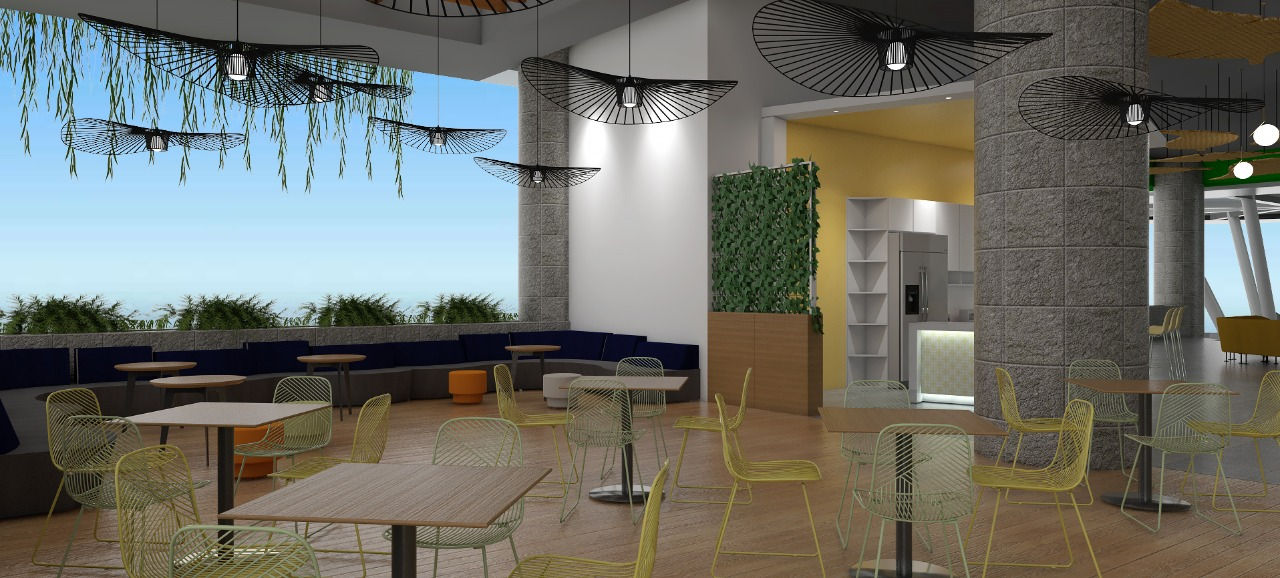
The interior design reflects a clean and modernaesthetic through the use of light-toned materials and contemporary forms. Dynamic and contemporary interior elements are introduced through patterns, colors, and spatial compositions that express campus identity and academic vibrancy.
The interior environment supports the concept of an eco-green and smart campus, encouraging communication, coordination, and collaboration. Interior spaces are designed to enhance creativity, productivity, and learning quality by supporting technology integration and flexible use. Environmentally friendly materials and efficient design strategies promote sustainable user behavior and reinforce environmental awareness within daily campus activities.
Landscape Concept
The landscape design complements both the masterplan and the building concept by creating a cohesive and memorable outdoor environment. A timeless design approach ensures that the landscape character remains relevant and adaptable over time. Accessibility is designed to be safe and efficient for users of all ages, supporting inclusivity across the campus.
Dramatic and memorable spaces are created through thoughtful spatial sequencing and landscape elements, while microclimate comfort is enhanced through vegetation, shading, and water features. The landscape also promotes an active and healthy lifestyle, integrating functional and aesthetic elements that support physical activity, social interaction, and artistic expression.
Through the integration of masterplan, building, interior, and landscape concepts, Campus A UNJ is envisioned as an accessible, environmentally responsive, and character-driven academic environment, where architecture and landscape work together to support education, sustainability, and community life.