
Location
Bekasi, West Java
Client
UNJ
Project Types
Educational Building
Status
Planned Project
Building Area
7.971,82 sqm
Site Area
-
Scope of Works
Architectural Design, Landscape, Interior, Mechanical, Structure, Electrical, Plumbing
Highlights
Services
Building Planning
Appointment Year
2024
Completion Year
-
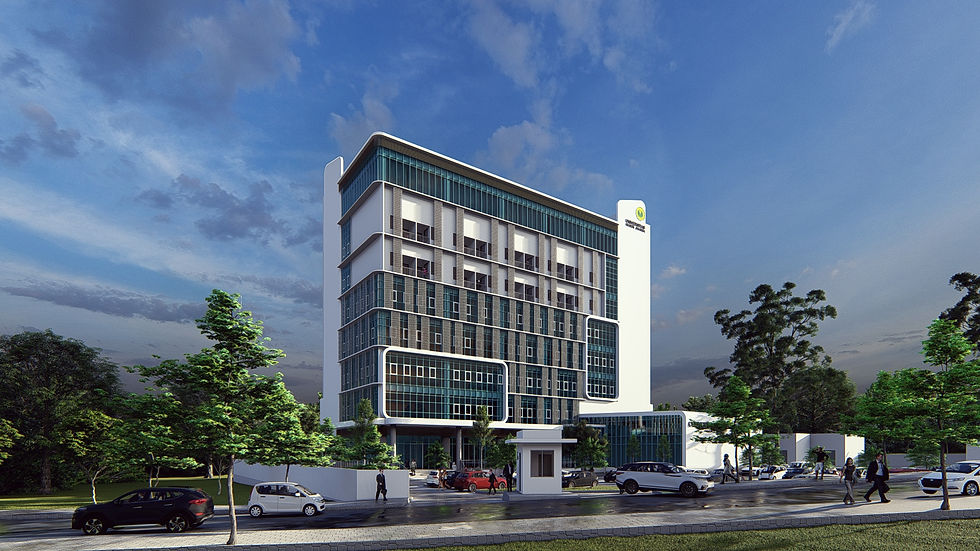
Gedung Sertifikasi Profesi (GSP) Universitas Negeri Jakarta
UNJ Cikarang is envisioned as a sub-urban campus that takes advantage of its vast and relatively undeveloped land. The availability of large open areas allows outdoor spaces to become the primary elements shaping the campus environment, rather than merely residual spaces between buildings. Each building is designed as an independent mass, not physically attached to others, yet integrated through a continuous system of open spaces and pedestrian networks that structure the campus as a whole.
At present, the UNJ Cikarang area is not supported by adequate basic infrastructure such as roads, utilities, and supporting facilities. This condition is not viewed as a limitation, but rather as an opportunity to plan the campus comprehensively from the earliest stages. The extensive green land and tranquil environment provide strong potential for the development of a sustainable and human-oriented green campus.
The GSP site of UNJ Cikarang is located in a suburban area on the edge of a major city. Although it does not directly intersect with the urban center, the site remains well connected to surrounding urban areas. Covering approximately ±80 hectares, the site is largely vacant land that is technically not yet ready for construction and therefore requires gradual land preparation. Basic infrastructure such as road networks, water supply, electricity, and other utilities are addressed as integral components of the overall campus planning strategy.
Open Space as the Primary Spatial Connector
Given the expansive and open character of the site, green areas are strategically utilized as public spaces that are closely integrated with the buildings. These open spaces function not only as ecological buffers, but also as communal spaces that support academic life, social interaction, and informal learning activities. This approach aligns with UNJ’s vision to become a university with a strong reputation in the Asian region by providing a healthy, inclusive, and sustainable learning environment.
Within the sub-urban campus concept, the relationship between buildings is not established through dense and compact massing, but through a network of open spaces, plazas, and pedestrian corridors. These spaces act as the main connectors between buildings, while simultaneously serving as social nodes that encourage interaction, collaboration, and outdoor activities.
Pedestrian-Oriented Site Planning and Circulation
The site planning of UNJ Cikarang adopts a pedestrian-oriented development approach, prioritizing walkability throughout the campus. Since the internal infrastructure network has not yet been developed, circulation is designed to emphasize pedestrian movement, while vehicular access is carefully controlled.
Parking areas are centralized in specific zones rather than distributed at each building, and mobility within the campus is supported by a shuttle system. This strategy creates a safer, more comfortable, and environmentally friendly campus environment for pedestrians.
Connected Buildings and Indoor–Outdoor Integration
At the building scale, a connected building concept is applied, integrating educational facilities with accommodation functions through shared spaces rather than physically attached structures. The connection between these functions is articulated through public spaces that act as a “third place,” mediating between formal spaces such as classrooms and residences.
These shared areas support collaborative work, informal discussions, dining activities, and daily social interaction. The design emphasizes a strong relationship between indoor and outdoor spaces, where public interior areas are directly connected to landscaped open spaces and plazas. This spatial continuity allows campus activities to flow naturally from inside to outside and reinforces the plaza as the central public space of the campus.
Green Architecture and Climate-Responsive Design
As part of the development on previously vacant land, the design of UNJ Cikarang adopts a green architecture approach that is integrated into both site and building design. The campus maximizes the use of natural energy to reduce dependence on artificial lighting and mechanical ventilation, while building orientation, openings, and spatial configuration are designed to optimize daylight and natural airflow.
The architectural design responds sensitively to local climatic conditions by considering solar orientation, prevailing winds, and microclimatic factors. Building placement and massing follow the UNJ Cikarang master plan to ensure environmental efficiency and spatial coherence.
Respect for the site is reflected in the approach to landform and topography, where natural contours are followed and earthworks are minimized to reduce environmental impact. At the same time, buildings are designed to function independently, particularly in the initial phases of campus development, ensuring that each building accommodates user needs, provides essential facilities, and supports both academic and social activities.


